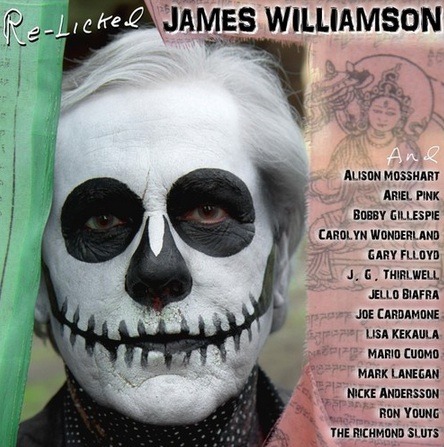
Stooges’ guitarist James Williamson has a solo album, Re-Licked, of Stooges’ songs that were never officially released due out October 29, 2014.
We’ve heard a couple of tracks off it.
Now here’s another taste.
The Orwells’ Mario Cuomo sings while Williamson delivers the riffs we love.
[I just published my rock ‘n’ roll novel, True Love Scars.” I’ve got a Goodreads. book giveaway going right now. The giveaway will be over in about five hours. Click here and enter.]
The upcoming Lost On The River: The New Basement Tapes, is an unexpected delight.
I’ve been listening to the 20-song deluxe version for nearly a week now, and despite my initial skepticism — how could anyone but Dylan write music to Bob Dylan lyrics — the actual recordings make for wonderful album.
Highlights include the Jim James sung opening track, “Down On The Bottom,” both versions of the title track, “Lost On THe River,” Rhiannon Giddens’ “Spanish Mary,” as well as “Kansas City” and both versions of “Liberty Street.” And there are many more gems.
Today a second track off the album, the terrific “Married To My Hack,” sung by Elvis Costello, was released.
Dig it.
The key to enjoying this album is not to compare it to the “Basement Tapes,” or any other Dylan album.
Think of it instead as a T Bone Burnett concept album, in which he was brought together a great group of musicians/sings and got them to write an eclectic batch of songs that somehow fit together.
Of course we know that Dylan wrote the words, or at least most of the words, but think of that as a bonus.
On its own merits, not compared to anything, this is a very good album.
[I just published my rock ‘n’ roll novel, True Love Scars.” I’ve got a Goodreads. book giveaway going right now. The giveaway ends in about 12 hours, so if you want to enter, now is the time. Click here and enter.]
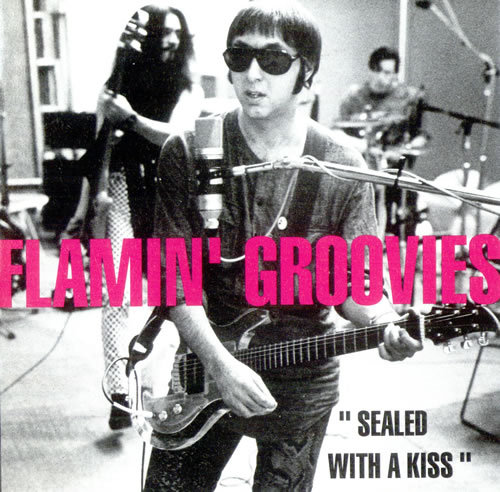
The Flamin’ Groovies ’70s classic, “Shake Some Action,” is one of the ten songs Greil Marcus writes about in his new book. Pictured is the cover of an early ”90s single by the group.
Ten songs that shook the world!
By Michael Goldberg
I’ve learned quite a few things from the critic and cultural historian Greil Marcus over the years, but maybe the first – and the one I keep coming back to — is that when listening to music, the artist’s intention isn’t so important. What really matters is what you and I, as listeners, hear.
You know, what we get from the music.
“I was never interested in figuring out what the songs meant,” Marcus wrote in the prologue to his book, “Bob Dylan, Writings 1968 – 2010.” “I was interested in figuring out my response to them, and other people’s responses. I wanted to get closer to the music than I could by listening to it – I wanted to get inside of it, behind it, and writing about it, through it, inside of it, behind it was my way of doing that.”
Marcus has been sharing his response to the music since the late ‘60s. In “Mystery Train” and “Lipstick Traces,” “The Old, Weird America: The World Of Bob Dylan’s Basement Tapes” and other books he uses art as a doorway, and steps through it to find vast secret histories, histories of America and Europe that mostly hadn’t made it into the history books – at least not in the way Marcus writes.
After reading “Lipstick Traces,” which starts with Johnny Rotten and then proceeds to spin into a history of anarchistic rebellion going back long before Johnny Rotten was born – I haven’t been able to listen to a Sex Pistols or Public Image Ltd. song without thinking of Dada and the Situationists and the May ’68 protests in France and so many other things that Marcus wrote about in that book.
This new one, “The History of Rock ‘n’ Roll in Ten Songs” (Yale University Press, 320 pages), is all about what Marcus hears when he listens to ten songs, and what he hears is unexpected and sometimes revelatory. It’s not any kind of history of rock that you or I have ever read before, because Marcus sees no point in revisiting the same old story that we’ve read numerous versions of since the ‘60s.
“Shake Some Action” is one of ten songs Marcus writes about in the book.
One of the big ideas in the book is that the chronological history of rock ‘n’ roll – that blues and country begat Chuck Berry and Elvis begat Dylan and the Beatles and so on and so on, is, if not irrelevant, beside the point. Or if not beside the point, well, we’ve been there. We all know, or think we know, the contours of that story. Marcus has a different story to tell.
“Whole intellectual industries are devoted to proving that there is nothing new under the sun, that everything comes from something else – and to such a degree that one can never tell when one thing turns into something else,” Marcus writes in the introduction to his book. “But it is the moment when something appears as if out of nowhere, when a work of art carries within itself the thrill of invention, or discovery, that is worth listening for. It’s that moment when a song or a performance is its own manifesto, issuing its own demands on life in its own, new language – which though the charge of novelty is its essence, is immediately grasped by any number of people who will swear they never heard anything like it before – that speaks. In rock ‘n’ roll, this is a moment that, in historical time, is repeated again and again, until, as culture, it defines the art itself.”
He continues:
“’It’s like saying, “Get all the pop music, put it into a cartridge, put the cap on it and fire the gun,’ Pete Townshend of the Who said in 1968. ‘Whether those ten or 15 numbers sound roughly the same. You don’t care what period they were written in, what they’re all about. It’s the bloody explosion that they create when you let the gun off. It’s the event. That’s what rock and roll is.’ Any pop record made at any time can contain Pete Townshend’s argument. … which is to say that this book could have comprised solely records issued by the Sun label in Memphis in the 1950s, only records made by female punk bands in the 1990s, or nothing but soul records made in Detroit, Memphis, New York City, San Antonio, New Orleans, Los Angeles and Chicago in 1963.”
And more:
“From that perspective, there is no reason to be responsible to chronology, to account for all the innovation, to follow the supposed progression of the form. The Maytals’ ‘Funky Kingston’ is not a step forward from the Drifters’ ‘Money Honey,’ or Outkast’s ‘Hey Ya’ a step forward from ‘Funky Kingston.’ They are rediscoveries of a certain spirit, a leap into style, a step out of time. One can dive into a vault as filled with songs as Uncle Scrooge’s was filled with money and come out with a few prizes that at once raise the question of what rock ‘n’ roll is and answer it.”
I’ve been reading reviews and books by Marcus since the late ‘60s, and he’s dead serious about what he puts on the page. And about what he discovers when he listens to and then writes about rock ‘n’ roll. This is serious stuff, life or death, and if you think music is nothing more than entertainment, well this book is probably not for you.
Reading Marcus is hard work because you have to think when you read his sentences. He takes for granted that you know a hell of a lot about music and art and film and literature. He’s not into coddling the reader. So when he calls his book “The History Of Rock ‘N’ Roll In Ten Songs,” it’s not that you’re going to get the literal history of the music, what you’re going to get is a theory about rock ‘n’ roll, and then ten examples that, in different ways, back up that theory.
So Marcus takes his ten songs and writes an essay about each. He works hard to tell us why these songs matter so much to him, why each in its own way contains the history of rock ‘n’ roll, and why they should matter to us too. And after you read this book, they likely will.
Read the rest of this column at Addicted To Noise, and dig many other great music features, news and reviews.
Neil Young is recording an album that will include songs with “big band arrangements,” according to music contractor Gina Zimmitti, who is involved with the project, and who posted photos and wrote about the sessions on the Facebook page for her company, Gina Zimmitti Music Contracting.
Zimmitti wrote that at one session, the musicians played “awesomely loud big band arrangements.”
Young has used an orchestra in the past, most notably on the songs “Expecting to Fly” and “Broken Arrow” recorded with Jack Nitzsche that appeared on Buffalo Springfield Again, and on the Harvest tracks, “A Man Needs A Maid” and “There’s A World” which Nitzsche recorded with the London Symphony Orchestra in London.
Violinist Marc Sazer has participated in at least one of the recent sessions and wrote on his Twitter page, “Recording with @neilyoung, great to have a great choir live in the room with us!”
Neil Young project today. Arranger/ conductor Chris Walden. Contractor Gina Zimmitti pic.twitter.com/cAkkAEciRH
The album is titled Storytone, according to arranger/conductor Chris Walden, who posted that information on his web site, along with a release date of November 4, 2014, but has subsequently removed that info from his site and replaced it with “untitled” and “2014.” Of course Neil Young is known for changing things at the last minute, so it’s possible that the title and release date could change, or even that Young could decide not to release the album at all.
Walden, according to Wikipedia, is known “for writing big band and orchestral arrangements for recording artists such as Michael Bublé, Diana Krall, Jennifer Hudson, Paul Anka, and Christopher Cross. He has been an arranger for ‘American Idol’ since 2007 and has worked for producers like David Foster, Phil Ramone, and Tommy LiPuma.”
The possible album title, Storytone, apparently refers to a rare early electric piano that Young may be using on the album.
Rare 1939 Storytone piano.
On the Piedmont Piano Company website is info about the Storytone piano pictured above:
This is an extremely rare and historically important instrument. The Storytone piano was built in 1939 in a joint venture between Story & Clark and RCA – the piano has normal strings and action but no soundboard – the sound is amplified by pickups and a speaker system making it the world’s first practical electric piano. The sound is very beautiful considering its design during the infancy of amplified instruments. As you can see the design is striking – art deco at its most radical.
Sessions for the album have taken place at Sony Pictures Scoring Stage and at EastWest Studios, both in L.A., during the last two weeks of August. Young concluded a tour of Europe with Crazy Horse on August 8 of this year.
Niko Bolas, who has worked with Young on such albums as This Note’s for You, Freedom and Living With War, is producing, according to Gina Zimmitti.
On August 19, Zimmitti posted:
“We don’t feel cheesy calling this one a ‘precious moment,’ and posted this photo:
Zimmiti wrote about this photo: George Doering, Chris Walden, and Neil Young (L to R). First day recording Chris Walden’s fantastic arrangements for Neil Young. — with Chris Walden at Sony Pictures Scoring Stage.
On August 23, Zimmitti wrote:
“2nd day of recording with Neil Young and producer Niko Bolas – this time for some awesomely loud big band arrangements by Chris Walden composer-arranger ! — with Chris Walden at EastWest Studios.”
She also posted this photo on August 23:
On August 27, according to Zimmitti, Young and the orchestra were back in the studio for more days of recording, this time working with arranger Michael Bearden.
Bearden has worked many successful musicians including Madonna, Whitney Houston, Lionel Richie, Chaka Kahn, Patti Austin, James Ingrahm, Babyface, Lenny Kravitz, Yoko Ono, George Benson, Natalie Cole, Anita Baker, Edie Brickell, Nancy Wilson, Stevie Wonder, Aretha Franklin, Liza Minelli and Michael Jackson.
Speaking to Billboard earlier this year, Young said, “I have new songs that I’m working on, and I haven’t stopped doing that. I do it when I feel like it and I’m collecting them. And sometimes I play them live before they come out as a record, and because of the way everything is people hear them before they come out, on the Internet. But I still feel like I’m gonna make records of them.”
One song that Young performed live numerous times this summer with Crazy Horse in Europe is called “Who’s Gonna Stand Up And Save The Earth?”
“I’d like to make a record with a full-blown orchestra, live – a mono recording with one mic,” Young told Billboard. I want to do something like that where we really record what happened, with one point of view and the musicians moved closer and farther away, the way it was done in the past. To me that’s a challenge and it’s a sound that’s unbelievable, and you can’t get it any other way. So I’m into doing that.”
However based on the photos, these sessions utilized numerous microphones. Oh well.
Some of Neil Young’s fans are skeptical regarding the project.
At Steve Hoffman Music Forums, a fan using the name “P(orF)” wrote, “It’s sad because I’ve been listening to him for 45 years, but my only reaction when I hear he’s doing a new recording is ‘What’s the gimmick this time?'”
And “Babyblue” added, “Yep, more and more Neil seems to be more about the gimmick than the actual music. I can see how this could happen to a veteran musician (especially a creative and eccentric one like Neil). It probably keeps things interesting. Unfortunately, it doesn’t always produce good music.”
But there were fans who defended Young. “Six String” wrote, “I’ll wait until I hear the music before passing judgement. It’s only a gimmick if it doesn’t work…”
[I just published my rock ‘n’ roll novel, True Love Scars.” I’ve got a Goodreads. book giveaway going right now. It’s over sometime September 2, so if you want to enter, now is the time. Click here and enter.]
[I just published my rock ‘n’ roll novel, True Love Scars.” I’ve got a Goodreads. book giveaway going right now. It ends at some point on Sept, 2, so if you want to enter, now is the time. Click here and enter.]